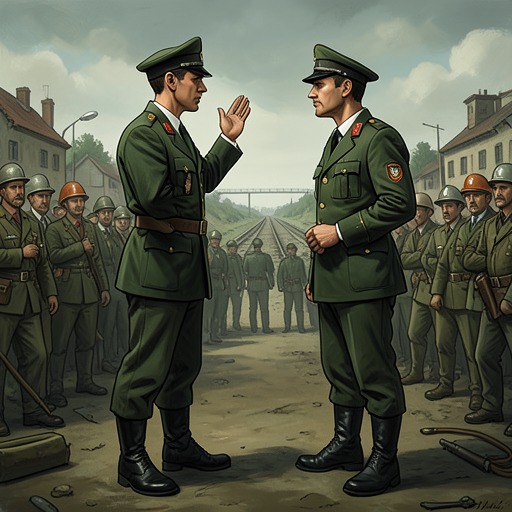
Lieutenant Fukuhara
The Narrow Road to the Deep NorthLieutenant Fukuhara is the Japanese officer who oversees the selection of prisoners for railway labor and serves as the interpreter between Major Nakamura and Dorrigo Evans. His role is practical and consequential: he turns a dispute over how many sick and exhausted men can work into an exchange of orders, claims, and refusals. The scene also makes him the audible voice of an ideology that treats health as a matter of will, even as the camp’s illness and deaths make that belief materially untenable.
Identity and Introduction
When the prisoners assemble in heavy rain, Lieutenant Fukuhara oversees their selection while the Japanese officers wait for the worst of the downpour to pass. His appearance is contrasted with Major Nakamura’s: where Nakamura’s uniform is bedraggled and his shirt marked by mould, Fukuhara looks as though he has stepped off a parade ground. The contrast establishes a visible difference in bearing, but the passage gives Fukuhara no independent account of his background or private life. He is introduced through his position in the camp’s machinery of command and, especially, through his work translating orders.
That work places him between Japanese authority and the Australian prisoners, but not outside the authority he conveys. He supervises the selection and translates Nakamura’s demands; his words make the officer’s decisions intelligible to the assembled men. The scene does not show him challenging the demands or speaking for the prisoners. His significance here lies in the way he transmits power: the order arrives in another language, but it remains an order.
The Labor Quota and the Camp’s Numbers
Before the selection can proceed, Dorrigo Evans reports the condition of the prisoners to Major Nakamura. The camp has 838 men: 67 are in the cholera compound, 179 are hospitalized with serious illness, and another 167 are too sick for anything beyond light duties. Dorrigo also points out 62 men reporting sick that morning. After accounting for these categories, he says only 363 men are available for railway work. The figures make his case a medical and logistical one: the requested workforce cannot be separated from the population already dying or incapacitated.
Lieutenant Fukuhara translates Nakamura’s demand for 500 prisoners. When Dorrigo says that there are not 500 fit men and that cholera is destroying the camp, Fukuhara answers with Nakamura’s insistence that the Australians should wash as Japanese soldiers do, taking a hot bath every day, and would then avoid cholera. The suggestion lands against conditions that make it impossible: the prisoners have no baths and no time to heat water even if baths were available. Dorrigo experiences the remark as bitter mockery. Fukuhara’s translation thus carries not only a quota but an explanation that ignores the practical limits Dorrigo has just described.
Dorrigo eventually argues that sending more than 400 men would achieve nothing for the Emperor: men would die who could be useful after recovering. Four hundred, he says, is the most the camp can provide. Nakamura will not accept that figure. He settles on 430, and the negotiation continues through the force of his insistence rather than through agreement about the prisoners’ health. Lieutenant Fukuhara’s interpreting connects these positions, but does not reconcile them.
Translating Military Ideology
The public address to the prisoners shows how translation turns command into doctrine. Nakamura speaks from a white bentwood chair; after he finishes, Lieutenant Fukuhara tells the men that Nakamura takes pleasure in leading them on railway construction but regrets the seriousness of their health problems. He presents the illness as evidence of an absence of Japanese belief, then conveys the principle that health follows will. In the Japanese army, he says, failing to reach an objective because of poor health is considered shameful, while devotion through death is praised.
Nakamura speaks again from the chair, remaining there to look along the ranks after his brief address. Beneath him, Lieutenant Fukuhara relays the expectation that the Japanese are prepared to work and the Australians must work too; if the Japanese eat less, the Australians must eat less. He also conveys Nakamura’s expression of regret and the prediction that many men must die. The sequence binds bodily deprivation to military duty: hunger and illness are not treated as reasons to stop work, but as conditions the prisoners are ordered to endure. Fukuhara’s translated words give that demand a stated rationale, even as the men’s circumstances contradict its confidence in willpower.
The Final Exchange and Narrative Role
During the haggling, Nakamura beats an Australian prisoner and then stops. He and Dorrigo exchange a prolonged look; in that silent confrontation, the narration presents each as understanding the other’s resolve without the help of translation. Only after this wordless contest does the bargaining resume. The moment marks a limit to Lieutenant Fukuhara’s function: he can carry spoken positions between the officers, but the scene’s central assertion of equality and refusal passes between Dorrigo and Nakamura without his mediation.
Nakamura fixes the labor figure at 430 and refuses to move. As he speaks forcefully, Lieutenant Fukuhara translates the claim that the Emperor wills it. Dorrigo replies that he knows. Fukuhara says nothing. This silence is his clearest action in the final exchange, and the passage does not explain it as agreement, protest, or fear. Instead, the absence of another translation leaves the imperial demand exposed in its starkest form: the numbers have been argued, the human cost has been named, and the appeal to authority closes the discussion without answering either. Lieutenant Fukuhara’s role is therefore not merely to make the Japanese officers’ speech accessible. His successive translations reveal how medical facts, military doctrine, and imperial command collide in the camp, while his final silence marks the point at which translation can convey an order but cannot make it morally persuasive.